



It does not receive public funding
Editor in chief:
CLARA MOSCHINI
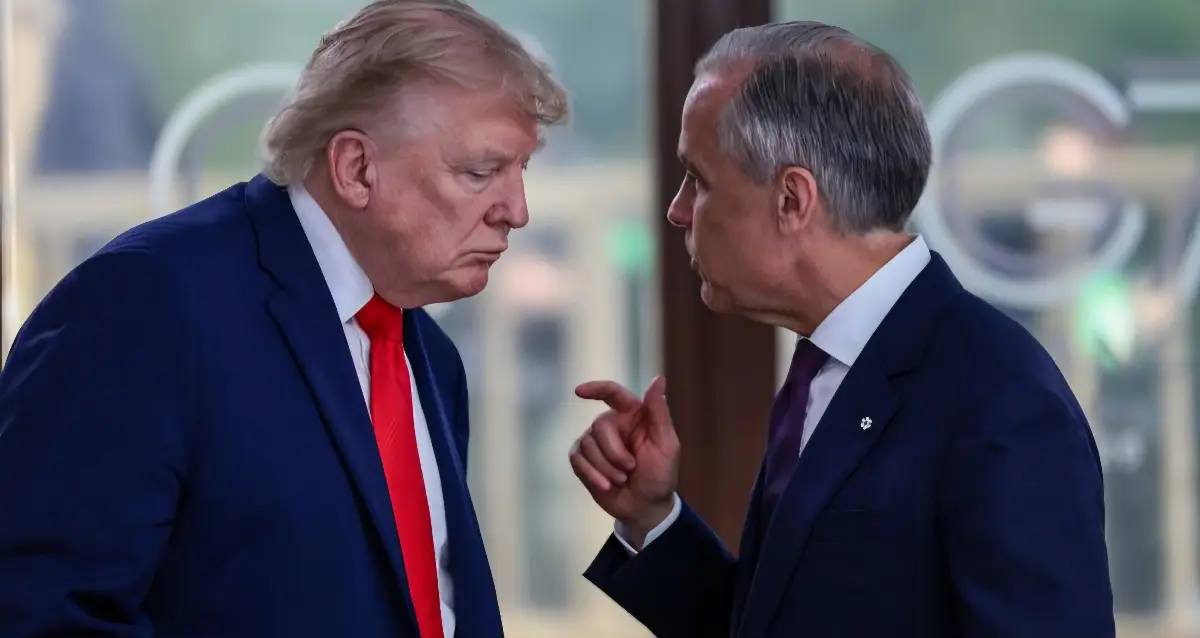
The truce, let's call it that, lasted all of a morning, or rather, a night. Negotiations between Canada and the United States to avoid a new wave of tariffs (see EFA News ) collapsed definitively overnight between Friday and Saturday: at 12:01 a.m. Eastern Time on Saturday, 50% tariffs on hundreds of Canadian products went into effect.
In short, as many observers predicted, the talks between Canada and the United States have turned sour. Canadian Prime Minister Mark Carney has withdrawn from three-day negotiations with US President Donald Trump . Carney has thrown in the towel, protesting what he claims are "unfair" terms requested by the United States for the trade deal.
New 50% tariffs have thus come into effect on over $20 billion worth of Canadian goods, equivalent to 5% of Canadian exports to the United States. They affect goods including plywood, cement, wine and other spirits, dairy products, electrical equipment, plastic products, furniture, paper, and even hockey equipment (which, remember, is Canada's national sport).
And that's not all, because now Washington, or rather Trump himself, enraged by the outcome of the negotiations, is considering other measures. This is a major risk for Carney , who, for his part, promises a "dollar for dollar" response. But it's also a major risk for the US president, who is hitting an economy deeply integrated with the US one: the shockwave of the tariffs, in short, risks overwhelming US companies themselves, linked to cross-border production chains. The value of bilateral trade exceeds $1 trillion, and a prolonged escalation could translate into higher costs and a slowdown in growth for both countries. Industry associations from both countries have already called for an immediate return to dialogue, fearful of the risk of an uncontrollable spiral of tariffs and retaliation.
As announced by the Canadian Prime Minister, Canada's countermeasures against the United States will be launched on September 8 and will affect approximately $20 billion in U.S. goods, targeting steel, lumber, paper, appliances, and agricultural products.
In short, it's a trade war between the United States and Canada. Carney himself reiterated this, describing the conflict in harsh terms: "We're at war" on the trade front, he said bluntly, explaining that the country was the victim of a veritable attack. According to the prime minister, Ottawa had no choice but to reject the American offer: "They asked for too much and offered too little," Carney concluded.
Canada's reaction, the prime minister clarified, stemmed from the absolute need to protect its workers and factories. The US imposed conditions that Ottawa deemed completely incompatible with its economic interests and national sovereignty. Thus, Prime Minister Carney chose not to bow to the agreement and announced an immediate "dollar for dollar" response to protect "Canadian workers, farmers, families, and businesses."
For the Canadian government, the stakes go far beyond simple economic calculations and strike a deep chord. During the talks, the United States attempted to limit Canada's freedom to enter into trade agreements with other countries, further making demands that, according to Carney , even undermined the protection of the French language and Canadian culture. For Ottawa, accepting those clauses would have meant surrendering significant swathes of its autonomy.
"We are masters of our own destiny," Carney claimed, believing this crisis will make Canada stronger and less dependent on Washington. This hasn't happened, according to Washington, which accuses the Ottawa team of introducing new demands right in the final phase of the talks, particularly regarding tariffs on heavy trucks. The Canadian government rejects this version of events: Carney maintains that Canada merely set down extensively discussed conditions in black and white, and that it was the United States that hardened its position, even revoking exemptions for some Canadian-produced vehicles.
After the agreement to lower auto tariffs to 15%, tied to strict requirements on U.S. component content, Ottawa challenged the exclusion of some Canadian-made trucks from the benefits.
Carney noted that the Canadian delegation remained united from start to finish, while on the US side, expertise and positions appeared fragmented and less coherent. The White House, however, categorically denies the existence of any divisions or rivalries between its two chief negotiators.