



It does not receive public funding
Editor in chief:
CLARA MOSCHINI
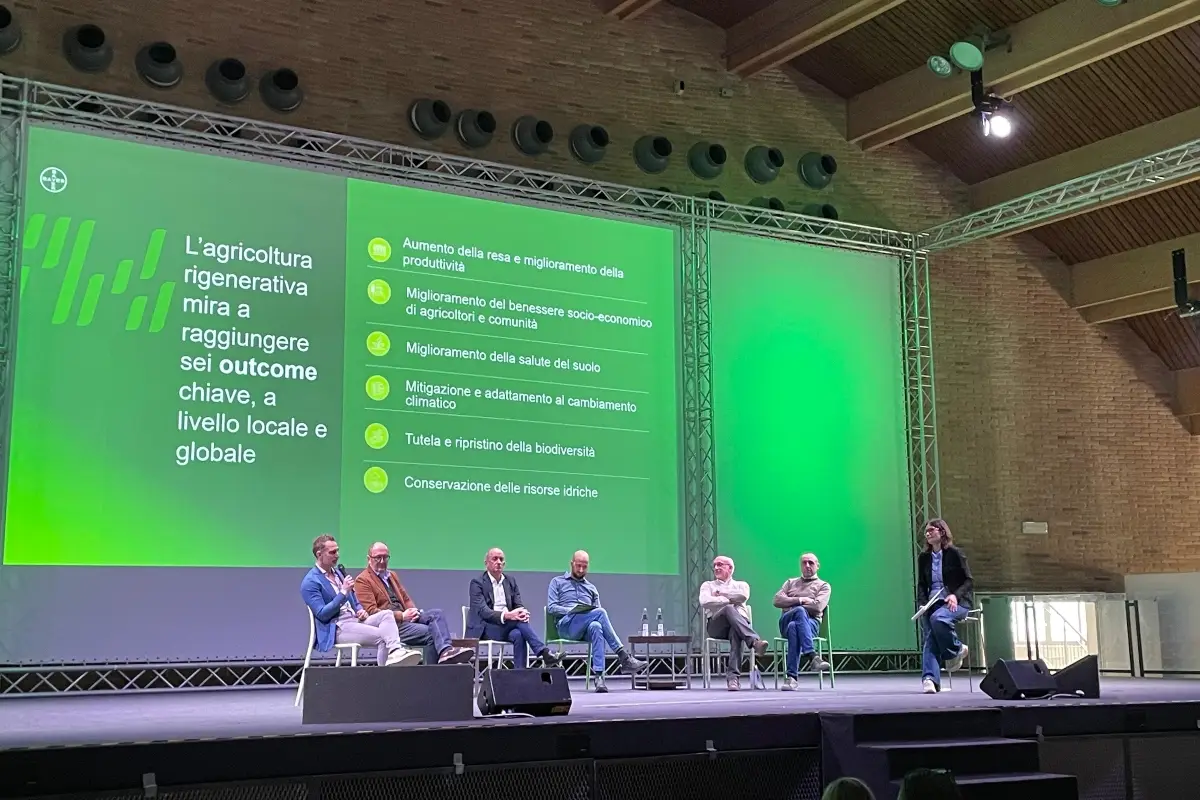
"Regenerate to Grow" was held today at the San Patrignano Auditorium (in the North of Italy, near to Rimini), an event sponsored by Bayer to present and share a concrete regenerative agriculture project applied to the winemaking industry. The company reaffirms its commitment to promoting a viticulture capable of combining innovation with the socioeconomic well-being of farmers and communities, protecting natural resources and profitability. All this to contribute to the development of a more resilient and long-term-oriented agriculture.
At the heart of this journey are the agricultural companies and partners who have chosen to work side by side with Bayer, sharing skills, experience and vision to accelerate the transition towards regenerative practices.
During the event, the experiences of the 2025 viticultural campaign, the initiative's first year, were presented, along with the objectives for 2026, in an increasingly challenging winemaking environment. The sector is faced with the effects of climate change, the evolution of pathogens and parasites, the alteration of vine phenological cycles, the current stringent regulatory framework, and the market's growing focus on environmentally friendly production. In this context, Bayer intends to be an active part of the change, supporting farmers embarking on a regenerative journey. "Regenerate to Grow" involves partner companies in Piedmont, Tuscany, and Veneto and integrates agronomic practices implemented by farms, innovative crop protection solutions, and digital decision support systems (DSS). These activities are complemented by specific biodiversity monitoring, as well as communication initiatives aimed at disseminating knowledge and fostering change along the supply chain.
"For Bayer, regenerative agriculture is a production model based on achieving key results," says Greta Pignata , Communications & Regenerative Agriculture Expert, Bayer Crop Science Italia, including: "increased yields and improved productivity, improved socioeconomic well-being of farmers and communities, improved soil health, mitigation and adaptation to climate change, protection and restoration of biodiversity, and conservation of water resources. The 'Regenerate to Grow' project is being developed within this framework."
During the discussion dedicated to field experiences, representatives of the four companies involved in the project—all leading names in the Italian winemaking scene and long committed to evolving toward more sustainable and regenerative viticulture: San Felice, Marcello del Majno, Fontanafredda, and Montaribaldi—shared the path they have undertaken in 2025. Joined by Bayer experts, they explained how the regenerative approach translates concretely into vineyard management through practices such as permanent grassing, reduced tillage and soil compaction, the maintenance of wooded areas, the adoption of innovative and sustainable crop protection solutions, the use of forecasting models to support phytosanitary decisions, and an increasingly community-focused approach.
"San Felice is among the pioneers of sustainable viticulture in Tuscany and actively participates in international networks dedicated to regenerative viticulture. It has long been working on restoring soil fertility and protecting biodiversity. In particular, with the "Regenerate to Grow" project, it has found a concrete and measurable path to strengthen this commitment," emphasizes Carlo De Biasi , General Manager of San Felice.