



It does not receive public funding
Editor in chief:
CLARA MOSCHINI
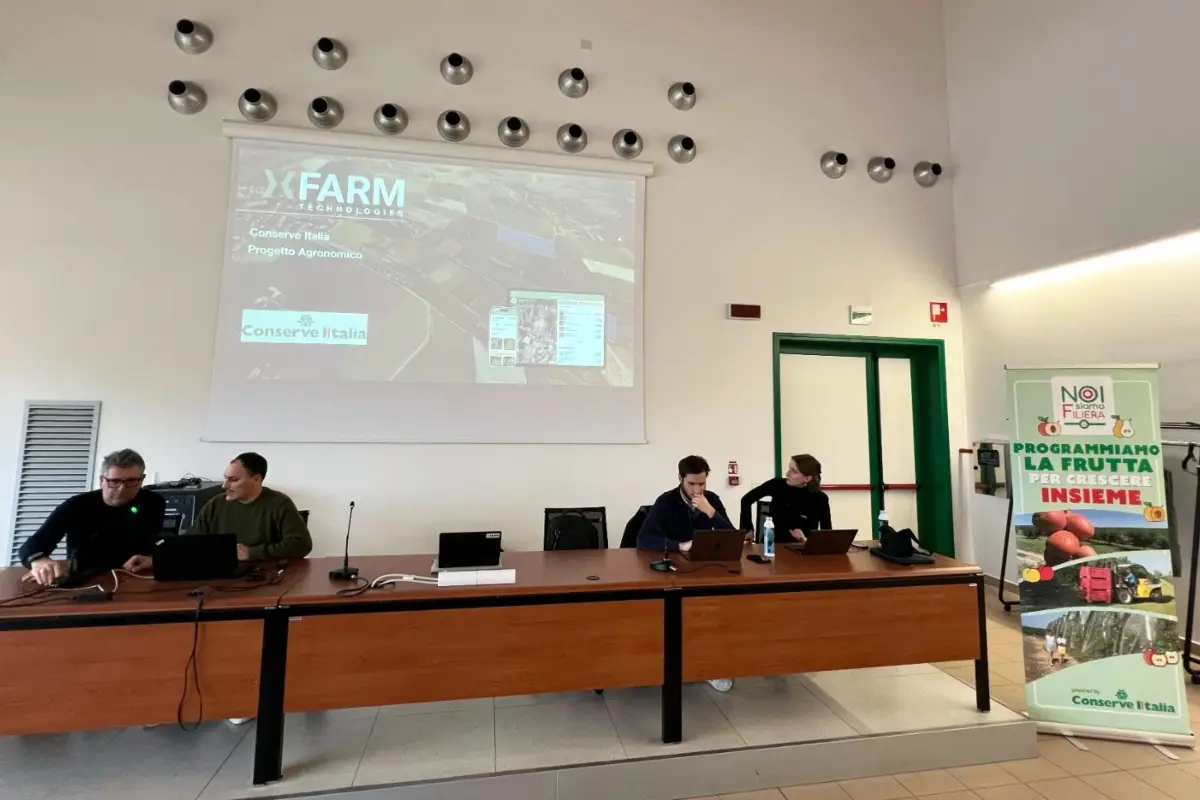
Data, technology, and expertise at the service of field decisions. The second training session of the Agrometeo project, promoted by Conserve Italia, concluded in Bagnacavallo (Emilia Romagna Region). This was a moment of direct discussion between technicians and Romagna fruit grower members to review what has been accomplished so far and look to the challenges ahead. The initiative, which took place on January 26th and 27th at the Agrintesa plant, involved nearly a hundred farms from the Romagna region. The sessions were divided into three sessions, focusing on the results of the 2025 trial and the 2026 objectives.
The Agrometeo project, developed by Conserve Italia's Agricultural Department in collaboration with xFarm Technologies and the University of Bologna, launched in the fall of 2023, creating the largest agronomic monitoring network in Italy in Emilia-Romagna, encompassing approximately 700 hectares of orchards with planned industrial production plantings. This network, based on field sensors and artificial intelligence, now supports fruit growers on multiple fronts, from irrigation to pest management and yield estimation.
"Agrometeo is a strategic investment for our membership base," says Daniele Piva , director of agricultural production at Conserve Italia, "because it promotes the digitalization of fields by providing farmers with concrete tools to address an increasingly complex environment, marked by climate change. Member training is the key to turning innovation into operational value."
During the two-day event, the main results of 2025, the first full year of testing, were presented. In terms of plant protection, the DSS (Decision Support Systems) developed for the main fruit crops (apricot, peach, nectarine, pear, and apple) demonstrated a good ability to identify risk windows for fungal diseases. In a particularly favorable year for disease development like 2025, long and recurring risk windows emerged, especially for pear, while for peach, the DSS for fusicoccum identified three main long risk windows related to rainfall and high humidity.
Regarding insect monitoring, traps with automatic recognition achieved an average accuracy of around 70% for the main species analyzed, confirming the technology's potential, although there is room for improvement for some targets. "The added value of DSS lies in the ability to understand when to intervene," explains Mattia Onofri , Fruit Manager at Conserve Italia, "making treatments more targeted and efficient. In 2026, we will work to further refine the models and adapt them to different business situations."
Ample space was also given to the FarmView project, the so-called "digital fruit counter" system, an innovative yield estimation tool based on automatic fruit recognition through video recordings and artificial intelligence algorithms. In 2025, three models for apricot, peach, and pear were tested, developed based on approximately 40,000 images compared with three years of historical production data. The contribution of the images to the estimate highlighted the need to integrate additional data sources to improve accuracy. "To obtain more accurate estimates," Onofri emphasizes, "we will need to integrate the images with additional information such as weather data, vegetation indices, and agronomic knowledge. This is the path forward."
Regarding irrigation management, the experiment conducted with the support of the Department of Agricultural and Food Sciences and Technologies (DISTAL) of the University of Bologna has shown encouraging results, with reductions in irrigation volumes exceeding 40% in some cases and a significant improvement in water use efficiency, without compromising the plants' water status. "We are still in the validation phase," says Luigi Manfrini , head of the Unibo research group for Agrometeo, "but the data clearly indicate the potential of irrigation DSS. Work will continue to consolidate the results and refine the models, as is inevitable during the experimental phase."
In 2026, the Agrometeo project will enter a new phase, aiming to make its tools increasingly reliable and integrated, strengthening and confirming Conserve Italia's commitment to building, together with its producer members, an increasingly innovative, efficient, and resilient industrial fruit growing industry. "This project demonstrates how technology can become a concrete ally of agriculture," concludes Giovanni Causapruno , Sales Director Europe of xFarm Technologies, "transforming collected data into faster and more sustainable operational decisions."